Tuesday, February 15, 2011

When I think of Black History Month (a re-post from 2007)

The following article was originally posted February 1, 2007. In celebration of Black History Month, I am re-posting it here. WWD

********************

During African-American or Black History Month, Americans recognize the many historic achievements and contributions of Blacks to the United States. The fact that a race of people kidnapped from their native land, separated from their families, tribes and culture, and subjected to forced slavery in this land could, in spite of such evil treatment, rise and achieve so much and contribute so critically to the building of this nation is nothing short of a miracle, and is a grand testimony to the grace and power of God. Ultimately, it was God who set Black slaves free in answer to their many prayers. It was the Lord who brought Blacks through Reconstruction and the emergence of the Ku Klux Klan. Almighty God delivered Black people from lynchings, “Jim Crow” and forced segregation. God, in answer to the prayers of our slave forebears, brought about the victories of the Civil Rights Movement. In a real sense, Black History is a vivid illustration of the grace of God.

But, Black History is not just about famous people and events, but about ordinary Black families. When I think of Black History, I think of my family. I think of my great-great grandfather, Richmond Duncan, who migrated from Florence, Alabama to North Chicago, Illinois (a small city some 35 miles north of the city of Chicago) in April of 1921, during the period American historians call “the Great Migration”. The son of former slaves, he was almost 50 years old at the time. His original intent was to settle in Michigan, but not finding anyplace to his liking, he decided to visit his wife’s uncle, Jack Fowler, in Waukegan. It was during this visit that he found a place that he liked in North Chicago, on the border with Waukegan. He purchased the house and sent a telegram summoning his wife, Frankie, and their two daughters, Minnie and Wylodine, and son, Fancie, to get their things together and come to Illinois.

I remember Richmond Duncan. I was almost 9 years old when he died in 1972. He lived to be almost 101 years old (100 years, 10 months and 7 days, to be exact). I’m thankful for pioneers like my “Grandpa Duncan.” I live in “Chicagoland” today because of Grandpa Duncan's desire for a better life for his family.

When I think of Black History, I also think of my great-great-great-great-great grandmother, Bettie Rice (yes, I used “great” 5 times). “Bettie” was the name given her by her owners, the Rice family. Bettie was a slave. I don’t think anyone ever knew when she was born, and there’s no one alive today who knows when she died. Based on what I was told, I think she died somewhere between 1899 and 1905. I own an old “tin-type” photo of her—the only picture of her—taken when she was an old woman, weary with years, but still carrying herself with dignity despite the horrors she had witnessed in her life. The other year, I made an enlarged copy of it, framed it, and hung it on the wall of our family room for all who visit our home to see. You see, Bettie holds a special place in our family for Bettie was born in Africa. She told her children and grandchildren that she was a Hottentot. The Hottentot were a tribe in southern and southwest Africa. I’m fascinated by an old story, passed down through the generations, that during slavery, Bettie once threatened to kill her own baby girl rather that have that baby sold away from her. Because of her fighting spirit, Bettie was allowed to keep that baby girl. Because an African Hottentot named Bettie refused to give up her child, our family remained intact and we still tell her story today.

Most of what I know about my family, I learned at the feet of my great grandmother—Richmond Duncan’s daughter, Bettie Rice’s great-great granddaughter—Minnie Duncan Gray. Minnie and her husband, William, raised me. Minnie had a phenomenal memory, and could talk at length about the family history. She knew both sets of her grandparents, all of whom had been slaves. I learned about slavery from one that had known and talked to former slaves. I learned from my great grandmother to appreciate family history and what my forebears had to endure so that I could be where I am today. I also learned from my great grandparents about the love of God in Jesus Christ, who died and rose again that I might have eternal life. This is the faith that has sustained many in my family since slavery days. This is the faith I am committed to passing on to my children.

Black people in the United States have come a long, long way. I believe strongly that Blacks should never forget those who came before us. And we should never, ever forget God who brought us through.

********************

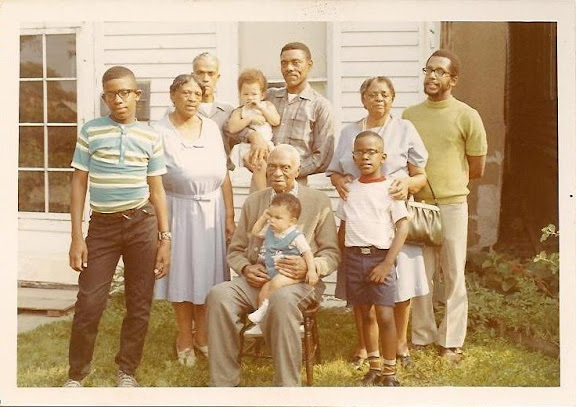
Some of you may have noticed that I recently added a photo to my profile (I finally figured out how it’s done). This photo is one of my favorites. It is from the latter half of 1971, as I remember, and it shows 5 generations of the Duncan family. Seated, in the center, is Richmond Duncan (1871-1972), my great-great grandfather. He was 100 years old at the time this photo was taken. The two women are his daughters, Minnie (to the left) and Wylodine (to the right). Minnie (1896-1986) is my great grandmother. Her husband, William (1905-1989), is behind her. Minnie and William took me in when I was 2 months old, and raised me to adulthood. My great-great aunt, Wylodine (1898-1998), who lived next door to us, probably did more than any other person to introduce me to Jesus. I cannot thank God enough for my great grandparents and my great-great aunt; by God’s grace, and because of them, I am what I am today. Standing behind Richmond is Minnie’s only child, my grandfather, Barney Quentin (1919-2000). On the far left and far right are Barney Q’s two sons, my Uncles, Barney David (on the left) and Charles (on the right). In Barney Q’s arms and on Richmond’s lap are Charles’ two oldest sons, my cousins, Adam [1969-2007] and Gabriel. Finally, standing to the right of Richmond, is me (one of the extremely rare photos of me in shorts). I was 8 years old.

Monday, February 14, 2011

Standing Strong

This past weekend, it was my privilege to preach 3 times—Saturday evening and twice on Sunday morning—at my home church, Christ Church Lake Forest. This was my very first time preaching at Christ Church. And God honored His word! He so graciously blessed us at each service. My sermon was from Ephesians 6:10-18a.

You may listen to the audio here.

Wednesday, February 02, 2011

Blizzard of 2011

Starting yesterday afternoon until this morning, we got at least 20 inches of snow in Chicagoland. Combined with wind gusts up to 40 miles-per-hour, it was quite a storm. Here’s the view outside our house this morning.


Praise the LORD, O Jerusalem!
Praise your God, O Zion!

He sends out his command to the earth;
his word runs swiftly.
He gives snow like wool;
he scatters hoarfrost like ashes.
He hurls down his crystals of ice like crumbs;
who can stand before his cold?

(Psalm 147:12, 15-17)

Tuesday, January 04, 2011

Learning contentment

“I have learned in whatever situation I am to be content. I know how to be brought low, and I know how to abound. In any and every circumstance, I have learned the secret of facing plenty and hunger, abundance and need. I can do all things through him who strengthens me.”
—Philippians 4:11-13

Of course, I haven’t “arrived” where Paul was, but this is my goal. Over the past nineteen months that I’ve been without a fulltime job, as I've thought more deeply about the fact of God's absolute sovereignty over absolutely everything (including my employment status, and the resulting financial strain for my family) I've come to see that discontent is really a form of unbelief.

In other words, when I'm discontented with my circumstances, I'm ultimately questioning God's choice to place me in these circumstances of partial employment and reduced income. If God is truly sovereign (and He is: Psalm 103:19; Daniel 4:35; Ephesians 1:11), and if He has the power to cause all things to work together for my good (and He does: Romans 8:28), then I have absolutely no legitimate reasons to be discontented with and complaining about any circumstances which God ordains for my life. Sometimes that’s a tough pill to swallow, but swallow it I must! The Lord does “all things well”, and He makes no mistakes.

Contentment, however, shouldn't be confused with apathy (I’m sure Paul would have preferred freedom to imprisonment). Being content doesn’t mean that I don’t care or that I must like my situation. Contentment is recognizing that whatever happens to me has been ordained by a good and sovereign God for my good. Contentment is the realization that God’s design is that I be a better man, conformed to the image of His Son. Contentment is the confidence that comes from knowing that God is not against me; He’s for me. Contentment is simply trust in God’s word.

I admit it is exceedingly difficult for me to feel content with many of the things which are going on in my life right now. It’s no fun. But Scripture says I can be content, and genuinely feel contentment, “through him who strengthens me”—through the Holy Spirit (“the Spirit of Christ”, Romans 8:9) who dwells within me. How do I draw upon the power of the indwelling Christ? “The just shall live by faith”—faith in Christ.

I’m learning. I’m not “there” yet. Nevertheless, I know God is good and, through the past nineteen month, has been good to me and my family. And He is sovereign. I can trust Him.

“And Are We Yet Alive”—New Year 2011

A fond memory from my days as a minister in the African Methodist Episcopal Church was the Methodist tradition of singing, at the opening service of each year’s Annual Conference, Charles Wesley’s hymn, “And Are We Yet Alive”. As a way of marking the beginning of another year writing this blog, I think it also appropriate to recall Wesley’s words.

And are we yet alive,
And see each other’s face?
Glory and praise to Jesus give
For His redeeming grace!

Preserved by power Divine
To full salvation here,
Again in Jesus’ praise we join,
And in His sight appear.

What troubles have we seen,
What conflicts have we passed,
Fightings without, and fears within,
Since we assembled last.

But out of all the Lord
Hath brought us by His love;
And still He doth His help afford,
And hides our life above.

Then let us make our boast
Of His redeeming power
Which saves us to the uttermost
Till we can sin no more.

Let us take up the cross
Till we the crown obtain;
And gladly reckon all things loss
So we may Jesus gain.

—Charles Wesley (1707-1788)

Thursday, December 16, 2010

They received the word with joy

This video is simply amazing: The Kimyal Tribe of Papua, Indonesia celebrating the arrival of the New Testament translated for the first time into the Kimyal language.

This video is also convicting, because I don’t love God’s Word as much as I should.

My heart echoes Tim Challies’ prayer.

“Have mercy on me, O God…”


HT: Tim Challies

Tuesday, November 16, 2010

The Danger of Covetousness

Yes! It worked!

With “a little help from my friends,” I was finally able to embed audio on my blog! Below is a recording of a sermon I preached back in August of this year: “The Danger of Covetousness”, based on Luke 12:13-21.

I thank God for Pastor Louis C. Love, Jr., and the very gracious people of New Life Fellowship Church, for giving me the opportunity to preach God’s Word.

May you be blessed as you listen.


Wednesday, November 03, 2010

Bind the “strong man”


“When we use God’s Word in accordance with his will, we have all the consent and power of the Almighty behind us. We therefore take the word of Jesus which commands us to bind the strong man…in order to spoil his goods (the souls of men held in his thrall). We shall find that when we exert ourselves to do this with an energy and devotion at least as keen as we apply to selfish pursuits, lo, people begin to respond to God’s Word, perhaps to our great surprise. It is not to be wondered at. The truth is that men’s hearts and lives are in fact in bondage to Satan (1 John 5:19), and when his power is broken, they are free to hear and heed God’s Word.

“This is a great secret; and yet many of us go on in Christian work year by year, dealing with men as if they were normally free agents willing and able to do what we say, or what they themselves will. They are not (Rom. 7:14-20), until God frees them in answer to prevailing prayer.”

From Towards Spiritual Maturity: Overcoming all evil in the Christian life (revised edition), by William Still (1911-1997), published by Christian Focus Publications, Ltd., pp. 77-78.

Tuesday, October 26, 2010

“My Song Is Love Unknown”

A wonderful hymn about our Savior’s love:

“My Song Is Love Unknown”


My song is love unknown,
My Savior’s love to me;
Love to the loveless shown
That they might lovely be.
O who am I, that for my sake
My Lord should take frail flesh and die?

He came from His blest throne,
Salvation to bestow;
But men made strange, and none
The longed-for Christ would know.
But Oh my Friend, my Friend indeed,
Who at my need His life did spend.

Sometimes they strew His way
And His sweet praises sing,
Resounding all the day
Hosannas to their King.
Then “Crucify!” is all their breath,
And for His death they thirst and cry.

They rise and needs will have
My dear Lord made away;
A murderer they save,
The Prince of Life they slay.
Yet cheerful He to suffering goes,
That He His foes from thence might free.

Here might I stay and sing,
No story so divine;
Never was love, dear King,
Never was grief like Thine.
This is my Friend, in Whose sweet praise
I all my days could gladly spend.

—Samuel Crossman (1623-1683), 1664

HT: Ray Ortlund

Saturday, October 09, 2010

Albertina Walker (Aug. 29, 1929 - Oct. 8, 2010)

In memory of the great gospel singer, Albertina Walker, who passed away yesterday morning: Here is a clip of her singing, “Lord, Keep Me Day by Day”, a song made popular by the Caravans, the gospel group Albertina organized in the early 1950s. What is so precious about this clip, recorded several years ago (probably early ‘90s), is the gospel music history that is gathered in the room. Many of the participants you see were pioneering figures in traditional gospel music.


UPDATE: Embedding was disabled for this video, so you may view it here, instead.