Tuesday, February 06, 2007

Concerning “the call” to pastoral ministry

An excellent post at “Irish Calvinist” asks the question, “Have I been called to pastoral ministry?” I heartily agree here with Erik Raymond. I must say, this is a subject very close to my heart. In fact, this subject—pastoral ministry—stands way apart for me as the only painful thing about by leaving the Black Church to unite with a predominantly white, evangelical church (If I can gather my feelings together into words, I’ll have more to say about this in a future post).

Monday, February 05, 2007

"Time To Leave"?

John Schroeder at Blogotional writes about when it is the right time to leave a church. My family and I experienced our own “Time To Leave” several years ago, but this may be helpful to someone else struggling with this kind of decision.

My experience in “cross-cultural missions” (Part 2)

The decision my wife and I made to leave the world of the Black Church for a predominantly white, non-denominational, evangelical church was made for doctrinal and theological reasons, and because we found a fellowship where we truly felt “at home”.

Many of us know there is a theological crisis in the Black Church. I, personally, see four aspects to this crisis in the Black Church. First, there is the health and wealth “gospel”, which is no gospel at all. This teaching is growing like an aggressive cancer in the Black Church. Formerly confined to the Pentecostal wing of the church, this teaching is now showing up in the preaching and teaching of more mainstream Black churches. I call this teaching a heresy because, quite simply, it is unbiblical. God does not promise Christians good health, and He doesn’t promise Christians material prosperity. Period. Secondly, it bears no resemblance to reality. There have been far too many poor and physically un-well saints throughout church history to give this teaching any credibility. Nevertheless, the health and wealth “gospel” continues to grow in popularity among the “have-nots” of society.

The second aspect of this theological crisis in the Black Church is neo-Pentecostalism. In saying this, I am not attacking classical Pentecostalism—not at all. What I am attacking is the new-style Pentecostalism that majors in the “gifts” and the “power” of Pentecost, but seems to avoid the holiness and simplicity of life, and faith in the Bible that characterized old-line Pentecostals. In short, you may have disagreed with certain doctrines of the old-line Pentecostals, but you couldn’t dispute their sincerity. It was “holiness or hell” for them. The world was something to be shunned. For the neo-Pentecostals, one can’t be so sure. There is great emphasis on church growth, emotionally high-pitched “worship” and financial and material “prosperity”, but gone is the sense that these people are dead-earnest about separation from the world and holiness of life. I believe neo-Pentecostalism is seen by many Black church leaders as a way to “grow” a church and, certainly, it has proven successful in multiplying the membership in many Black congregations found in various mainline denominations. But, I fear there is more Pentecostal “style” than there is spiritual “substance”.

The third aspect of this theological crisis in the Black Church is related to the previous two and, I believe, is responsible for the spread of neo-Pentecostalism and the health and wealth “gospel”: biblical ignorance. People just don’t know the Bible. From the front door of the church to the choir loft, including the pulpit, there is a phenomenal ignorance of Scripture. I’m almost embarrassed at some of the downright ign’ant (ignorant) things I’ve heard people say about what is in the Bible. Even preachers and pastors! Now, it must be said, the root of this biblical ignorance is the lack of education opportunities for Blacks in the past, because of American racism. However, I don’t feel that can be a valid excuse today. We’ve come a long way from where (as my great grandmother described it to me) even the preacher couldn’t read. The old, Black, country preacher just preached some verses he had memorized. That was something like a hundred years ago, when my great grandmother was a little girl. Most people today can read…at least, a little bit! And, if you can’t read, you can get the Bible on CD. There are tapes and CDs of Bible teaching available everywhere. Everybody that has a desire can learn something about the Bible. There are no more legitimate reasons, and absolutely no excuses, for biblical ignorance. Yet, biblical ignorance prevails all over the Black Church. My people are perishing for a lack of knowledge!

Which brings me to the fourth aspect of the theological crisis infecting the Black Church (and, probably, the source of all its contemporary problems): “Wolves” in the pulpit. I believe the Black Church is being destroyed by men (and women) in the pulpits whom God never called and never sent. These “wolves” prey on the “sheep” and cannot, by any objective, biblical standard, be considered Christian. They are dogs (If Paul could say it, I think I might venture to utter the term). I know those are strong words, but I’ve seen and met some of these folks! I’ve also seen (and experienced) the aftermath of their “ministry”. They are ruining souls. I see people get up-in-arms about priest sex scandals or about the Ted Haggards of the Church, but I think, “If you only knew what goes on all the time, unabated, in the Black Church!”

To make a long and complicated story short and simple, I finally took my family out from under all this. My wife was miserable, and I didn’t want my children to grow up thinking this was what church was all about. After leaving the historic Black Church, we had brief, but extremely unpleasant experiences with Black evangelicalism (again, a subject worth a blog post of its own). Finally, my wife and I came to the conclusion that we needed to look beyond race, in our search for a church, and simply look for a fellowship that believed, taught and followed Scripture, where we would truly be welcome.

God answered that prayer when He brought us to our current church home. In fact, I clearly see God’s sovereignty in bringing us to where we are today. In our journey, I see not only God’s sovereign hand, but I also see just how dauntingly wide the gulf is between the Black Church and white evangelicalism.

(To be continued…)

Truths we neglect

Adrian Warnock posts a quote from Dr. Martyn Lloyd-Jones on the subject of revival.

Saturday, February 03, 2007

My experience in “cross-cultural missions”

One of the recent trends in evangelicalism is the short-term mission trip. Instead of giving decades of one’s life to ministry for the cause of Christ in some faraway country—as legendary missionaries of the past like William Carey, Hudson Taylor, David Livingstone or Amy Carmichael did—today’s would-be missionary can give a couple or so weeks of service sacrificing little, risking little, investing little.

Without getting into the pros and cons of short-term mission trips, I have to confess I’ve never had even the slightest urge to go on one (I know that will sound like near-heresy to some). I figure, why should I go to another country for missions work when I’m already doing “cross-cultural missions”. You see, for the past 6 years my family and I have been involved in a predominantly white, non-denominational, evangelical church.

I hope no one will find my association of the term “cross-cultural missions” with involvement in a predominantly white church offensive. I’m simply acknowledging a cultural and sociological reality: There is a vast world of difference between the white evangelical church and church in the Black community. In fact, the move to a predominantly white church has meant learning a whole new way of “doing church”.

I’ve always been in church. My great grandparents were faithful church attendees and brought me to church every Sunday from the time I was 2 months old. Not only was I in church every Sunday of my life (unless I was sick—a rare occurrence), but I’ve been active in the church since childhood, ever since my great-great aunt “made me” come and play the organ for the brand new A.M.E. Church she became a part of way back in 1972. I was 9 years old at the time. So, for over 34 years I’ve been involved “up-front” in the church. I was active in the church even before I knew the Lord (I’ve been a Christian for a little over 26 years)! However, all my church experience, until 1998, was within the “Black Church”—within a Black local church in the Black community, within an historically Black denomination.

When we left the A.M.E. Church in 1998, we immediately united with a Black evangelical church (a Black local church which was part of a majority-white evangelical denomination). There were some significant differences between this Black church in a white denomination and a Black church within a Black denomination (a subject worth a blog post of its own), but I was still dealing with Black folk.

But, when my wife and I made the decision to attend a white church, we made a decision which (probably more so for me than for my wife) was earth-shaking. I don’t think I’m being overly dramatic in speaking of our decision in those terms. Leaving behind the comfort and security of Black people on Sunday morning meant leaving behind everything we had known and become used to. It meant leaving behind familiar sights and sounds. It meant singing new music or singing familiar music (hymns) in new ways. It meant a different way of worshiping, a new way of praying in public, and listening to a different way of preaching. It even meant learning a new language: “evangelical-speak”.

So, whenever the subject of short-term mission trips comes up, I think to myself, “I don’t need to go on a mission trip to experience and minister to another culture; I’m doing that right now!”

(To be continued…)

"Revival and the Baptism with the Holy Spirit"

Adrian Warnock has a link to an excellent paper by Dr. John Piper entitled, A Passion for Christ-Exalting Power: Martyn Lloyd-Jones on the Need for Revival and Baptism with the Holy Spirit. This paper was originally delivered at the 1991 Bethlehem Conference for Pastors.
In my opinion, the Church of Jesus Christ needs what is written about here.

Thursday, February 01, 2007

When I think of Black History

During African-American or Black History Month, Americans recognize the many historic achievements and contributions of Blacks to the United States. The fact that a race of people kidnapped from their native land, separated from their families, tribes and culture, and subjected to forced slavery in this land could, in spite of such evil treatment, rise and achieve so much and contribute so critically to the building of this nation is nothing short of a miracle, and is a grand testimony to the grace and power of God. Ultimately, it was God who set Black slaves free in answer to their many prayers. It was the Lord who brought Blacks through Reconstruction and the emergence of the Ku Klux Klan. Almighty God delivered Black people from lynchings, “Jim Crow” and forced segregation. God, in answer to the prayers of our slave forebears, brought about the victories of the Civil Rights Movement. In a real sense, Black History is a vivid illustration of the grace of God.

But, Black History is not just about famous people and events, but about ordinary Black families. When I think of Black History, I think of my family. I think of my great-great grandfather, Richmond Duncan, who migrated from Florence, Alabama to North Chicago, Illinois (a small city some 35 miles north of the city of Chicago) in April of 1921, during the period American historians call “the Great Migration”. The son of former slaves, he was almost 50 years old at the time. His original intent was to settle in Michigan, but not finding anyplace to his liking, he decided to visit his wife’s uncle, Jack Fowler, in Waukegan. It was during this visit that he found a place that he liked in North Chicago, on the border with Waukegan. He purchased the house and sent a telegram summoning his wife, Frankie, and their two daughters, Minnie and Wylodine, and son, Fancie, to get their things together and come to Illinois.

I remember Richmond Duncan. I was almost 9 years old when he died in 1972. He lived to be almost 101 years old (100 years, 10 months and 7 days, to be exact). I’m thankful for pioneers like my “Grandpa Duncan.” I live in “Chicagoland” today because of Grandpa Duncan's desire for a better life for his family.

When I think of Black History, I also think of my great-great-great-great-great grandmother, Bettie Rice (yes, I used "great" 5 times). “Bettie” was the name given her by her owners, the Rice family. Bettie was a slave. I don’t think anyone ever knew when she was born, and there’s no one alive today who knows when she died. Based on what I was told, I think she died somewhere between 1899 and 1905. I own an old “tin-type” photo of her—the only picture of her—taken when she was an old woman, weary with years, but still carrying herself with dignity despite the horrors she had witnessed in her life. The other year, I made an enlarged copy of it, framed it, and hung it on the wall of our family room for all who visit our home to see. You see, Bettie holds a special place in our family for Bettie was born in Africa. She told her children and grandchildren that she was a Hottentot. The Hottentot were a tribe in southern and southwest Africa. I’m fascinated by an old story, passed down through the generations, that during slavery, Bettie once threatened to kill her own baby girl rather that have that baby sold away from her. Because of her fighting spirit, Bettie was allowed to keep that baby girl. Because an African Hottentot named Bettie refused to give up her child, our family remained intact and we still tell her story today.

Most of what I know about my family, I learned at the feet of my great grandmother—Richmond Duncan’s daughter, Bettie Rice’s great-great granddaughter—Minnie Duncan Gray. Minnie and her husband, William, raised me. Minnie had a phenomenal memory, and could talk at length about the family history. She knew both sets of her grandparents, all of whom had been slaves. I learned about slavery from one that had known and talked to former slaves. I learned from my great grandmother to appreciate family history and what my forebears had to endure so that I could be where I am today. I also learned from my great grandparents about the love of God in Jesus Christ, who died and rose again that I might have eternal life. This is the faith that has sustained many in my family since slavery days. This is the faith I am committed to passing on to my children.

Black people in the United States have come a long, long way. I believe strongly that Blacks should never forget those who came before us. And we should never, ever forget God who brought us through.

********************

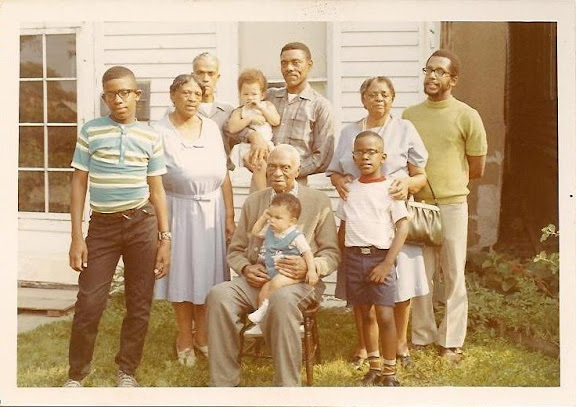
Some of you may have noticed that I recently added a photo to my profile (I finally figured out how it’s done). This photo is one of my favorites. It is from the latter half of 1971, as I remember, and it shows 5 generations of the Duncan family. Seated, in the center, is Richmond Duncan (1871-1972), my great-great grandfather. He was 100 years old at the time this photo was taken. The two women are his daughters, Minnie (to the left) and Wylodine (to the right). Minnie (1896-1986) is my great grandmother. Her husband, William (1905-1989), is behind her. Minnie and William took me in when I was 2 months old, and raised me to adulthood. My great-great aunt, Wylodine (1898-1998), who lived next door to us, probably did more than any other person to introduce me to Jesus. I cannot thank God enough for my great grandparents and my great-great aunt; by God’s grace, and because of them, I am what I am today. Standing behind Richmond is Minnie’s only child, my grandfather, Barney Quentin (1919-2000). On the far left and far right are Barney Q’s two sons, my Uncles, Barney David (on the left) and Charles (on the right). In Barney Q’s arms and on Richmond’s lap are Charles’ two oldest sons, my cousins, Adam and Gabriel. Finally, standing to the right of Richmond, is me (one of the extremely rare photos of me in shorts). I was 8 years old.

Wednesday, January 31, 2007

Seeing through these Black eyes

February, as everyone in the U.S. should know, is African-American or Black History Month. Carter G. Woodson (1875-1950), who is known as the father of Black History, believed that in order to participate effectively in American society, Blacks needed to know about their history, a history that, tragically, had been erased, obscured and ignored as a result of the evil of slavery and the racial prejudice and discrimination against African people and their descendants which gave birth to slavery and continued in slavery’s aftermath. Woodson believed it was necessary for all Americans to know the important and significant contributions that Blacks have made to America. I agree with Woodson. The need still exists.

For those who would like to know more about Carter G. Woodson, I have links here, here and here.

In the interest of Black History month, I’d like to do something different. I’d like to spend the majority of February writing especially from my “Black self”. That is, I would like to expose my readers to some of my thoughts as a Black, Christian man in America. My wife and sons are already familiar with my views, so nothing I’ll write will be news to them. I’ve talked about these things many times at our dinner table, while riding in the car, relaxing in front of the television or doing yard work. Nothing I will write is “news” to those who know me best. But to others, especially those who are not Black, much of my “Black self” remains hidden. In my opinion, wearing this kind of racial “mask” is necessary to smoothly navigate life in America. It’s a survival technique (In that vein, I would recommend you read the classic and eye-opening 1952 novel, Invisible Man, by the late writer and novelist, Ralph Ellison). However, masks do not promote understanding. This is why, in the interest of racial understanding, I would like to remove the mask and let non-Blacks see America and the evangelical church through these Black eyes.

I don’t think my racial views are all that unique among Black people—not at all. In fact, I think my views are pretty much middle-of-the-road. On one extreme, I’ve known Blacks who definitely harbor hostility and racism against whites. On the other hand, I suspect I’ve met a few Blacks who seem to have forgotten that they are Black (and, I don’t mean that as a compliment, by the way). I’m thinking of Black people who act as if they wish they were white, who look down their noses at people of their own race. In contrast to these extremes, I do not hate anyone of another race, neither do I reject my own race and racial heritage. Now, there have been times, because of hurtful racial experiences, when I have struggled with hatred against whites, and there have been other times when I’ve felt like turning my back in disgust on Black folks. However, as far as I know my own heart, at this stage of life I do not hate or feel hostility against anyone, and I love and respect (and like!) people of various races and ethnicities. And, I mean specific people, not just a nameless, faceless, nondescript group of people. Anybody can love people “in general”. I must give all glory to God because, more than once, I’ve had to pray for genuine love for people (white and Black) who’ve hurt me, and God has answered that prayer.

Most of what I have to write will be about Blacks and whites. I don’t mean to ignore other races or ethnicities, but the fact is, being Black in America has always been mainly about trying to live, work and relate with whites. So, please don’t take offense if I’m not talking about you; there will be something here, I think, for all to learn. However, there’s a history between Blacks and whites in America that goes back a l-o-n-g way. It is out of my personal experience, within this continuing saga of Black-white relations, that I will be writing.

So, I pray that you will bear with me. I pray that you will read and listen to what I’m trying to say, especially if you’re not African-American. I’m not trying to bash anybody or any group, but I’m concerned that the Church in America still doesn’t “get it”, when it comes to race. In particular, I think conservative, evangelical, Christian whites need to know what it’s like to be Black. You need to understand that not every Bible-believing, evangelical-minded Christian sees the world as you do. I’m going to try to share my heart. I pray that God will, in some way, use what I write for good and for His glory.

Tuesday, January 30, 2007

The preaching that we need to hear today

Anthony Carter came across a sermon that you need to hear (And, share with someone else!).

Links for both pulpit and pew

These links ought to motivate us to pray, both pulpit and pew:
Thabiti Anyabwile asks the question, Can the Predominantly African-American Church Be Reformed? God knows my heart aches for the Black Church. Read what our brother Thabiti has to say, and ponder this question for yourself.

For all you preachers: Zack Eswine had an article on the Reformation 21 website, titled, Seeking the Spirit: What Today’s Preacher Can Learn from Charles Haddon Spurgeon.

Also on the Reformation 21 website, and also for preachers, is an article by William Farley titled, Preaching to Obtain Humility.
And, you must read this: Why Blacks Are Leaving Evangelical Ministries: The Failure of Racial Reconciliation by Anthony Bradley. Read it, please, and consider.