Showing posts with label White. Show all posts

Thursday, September 10, 2009

“From within, out of the heart…”

Have you noticed all the fear, hostility and anger in the air of late? From the ongoing debate over national health care to the furor over the news that President Obama was going to address the nation’s schools, many Americans seem deeply upset.

I can imagine someone responding, “Of course, we’re upset! It’s because of all the [take your pick] liberal/socialistic/communistic/unconstitutional/anti-Christian/evil policies being forced upon this country by the Obama Administration!”

Apparently, it’s all the fault of President Obama.

Perhaps. But, I don’t think all this commotion is about policy. Whether at town hall meetings, on radio talk shows, at Internet blogs, or in reader comment sections in the newspaper, there is a level of public hostility, animosity and pent-up rage being directed at this President like I’ve never heard or read about before. Just last night, as our President was addressing a joint session of Congress regarding his proposals to overhaul healthcare, a congressman from South Carolina shouted “You lie!” Heckling directed at the President of the United States during a joint session of Congress by a congressman is simply unprecedented. That is, until now. No, this commotion is not simply about policy differences, conservative versus liberal, or because of a heightened sense of partisanship.

Jesus said, “What comes out of a person is what defiles him. For from within, out of the heart of man, come evil thoughts, sexual immorality, theft, murder, adultery, coveting, wickedness, deceit, sensuality, envy, slander, pride, foolishness. All these evil things come from within, and they defile a person” (Mark 7:20-23). All this contemptuous language that we are hearing and reading about daily is but a reflection of the contempt, hostility and anger that, unfortunately, resides in the hearts and minds of many white people in this country. Some may object to my singling out white people, but haven’t you noticed that practically all of these angry people all across America are white? I’ve not seen any black people on the news, ranting and raving at town hall meetings, have you? Predominantly, we’re talking about angry white people.

Which brings me to this unavoidable conclusion: I think what is fueling much of this rage and anger is nothing other than latent white racism. It’s not the only thing, but it is playing a significant role in the furor.

Latent—adj., “present but invisible or inactive; lying hidden and undeveloped within a person or thing, as a quality or power.”

Some people seem to believe racism is mainly a thing of the past. They think, sure, there may be a few hate groups here and there, out on the fringe of society but, for the most part, racism is a dead issue. Well, first of all, there are more than just a few of these “fringe” groups, and the number is growing. But, secondly, the 13th, 15th and 24th amendments to the U.S. Constitution, and several Civil Rights Acts, only made certain overtly racist acts illegal, and helped to dismantle the various forms of institutionalized racism that we had in this country. Racism, however, was never eradicated from our country, because racism is not a law written on paper, racism is a sin which resides in the human soul.

Having been “black in America” for 46 years now, I think I know a bit about racism. For the most part, the racism that we see in old black-and-white newsreels is gone. Racism today usually doesn’t parade around in white hoods, burn crosses on lawns, or lynch black men for being with white women (although it still, on occasion, hurls the “N-word” at black people). Today’s racism is much more sophisticated than the racism of the not-so-distant past. Today’s racism is very subtle and, therefore, hard to define. Because it’s so hard to pin down, it’s also very easy to deny. But, my sense, as a black man in America, is that the election of Barack Obama—an intelligent, highly educated and articulate “man of color”—as President of the United States has caused many white Americans to show their “true colors”, stirring up what has simply laid “hidden and undeveloped within”.

White America, the primary beneficiaries of America’s legacy of racism, has never truly acknowledged the sin of racism and turned wholeheartedly away from it. That has been the ongoing problem in the United States. White society just want blacks to forget about “it” and pretend it never happened, while at the same time they continue their practice of sophisticated, subtle racism. The Bible speaks of repentance. To repent is to turn around and turn away from sin. “Whoever conceals his transgressions will not prosper, but he who confesses and forsakes them will obtain mercy.” (Proverbs 28:13). Until there is a true turning away from racism by white America, there will never be true racial healing, and God will not heal our sick nation.

Jesus spoke what I believe is a relevant word regarding the racial tension that exists between whites and blacks, tensions which have always been present in our country: “So if you are offering your gift at the altar and there remember that your brother has something against you, leave your gift there before the altar and go. First be reconciled to your brother, and then come and offer your gift” (Matthew 5:23-24). Black people in America, historically, have been (and, to a degree, continue to be) on the receiving end of racism. And, contrary to what some may think, the effects of racism on black people are real, not imaginary. My white fellow-Americans, when it comes to racial reconciliation, according to Jesus, the ball is in your court.

There is also a part that black Americans must play: We must be willing to forgive. Black Americans shouldn’t assume all whites are racist, because that’s not true. In every conflict with whites, blacks shouldn’t simply assume racist motives are at work. Too many of us carry around a racial chip on our shoulders. We have to let that go. Jesus said, “For if you forgive others their trespasses, your heavenly Father will also forgive you, but if you do not forgive others their trespasses, neither will your Father forgive your trespasses” (Matthew 6:14-15). Personally, I’m not going to let white racism stand between me and God. If we black Americans are not willing to forgive, there will never be true racial healing, and God will not heal our communities.

I’ve stated it before: I do not believe that abortion or homosexuality are the greatest sins in America (they are sins, but not the greatest sins). For the most part, abortion and homosexuality are the sins of unregenerate or unsaved people (1 Corinthians 6:9-10). Racism, however, is alive and well, unrepented of and without remorse, within the church, among those who profess allegiance to the Lord Jesus Christ. I firmly believe, next to unbelief, racism is America’s greatest sin because it is one of the sins-of-choice of far too many of us who claim to be Christians. It was so at the founding of this nation, and it still true today.

I’m not optimistic that racism will ever be eradicated. Until Jesus comes back and permanently rids this world of sin and all its evil effects, there will be racism. Nevertheless, there is something God’s people—Christians—can do: “If my people who are called by my name humble themselves, and pray and seek my face and turn from their wicked ways, then I will hear from heaven and will forgive their sin and heal their land” (2 Chronicles 7:14). The church should be the one place where there is no racism. Christians have no business joining in all the angry, hate-filled, contemptuous speech that is out there. Stop listening to Rush Limbaugh, Glenn Beck, and their ilk and, instead, get in God’s word. After all, we’re supposed to be followers of a “more excellent way”.
Photo: Bradley C. Bower/AP

Thursday, June 12, 2008

“Proud” of my country?

This morning, in the Chicago Tribune, I read the following quote of Tennessee state GOP chair Robin Smith, about Michelle Obama (you may recall that Mrs. Obama stated, after one of her husband’s primary wins, that she felt “proud” of her country for the first time in her adult life):

“Her comments substantiated that Barack Obama and his wife don’t relate to the average American, who still flies the flag on the 4th of July, still gets chills when the Air Force planes fly over… It just feeds the narrative that they’re essentially out of touch with America.”

Personally, I found that comment insulting and condescending. Why? Because, I think I understand exactly what Mrs. Obama meant or felt when she made that oft-quoted comment. For one thing, Mrs. Obama and I share at least one thing in common: We are both Black. We have both experienced living as Black people in America. Am I, somehow, “out of touch with America” because I can relate to Mrs. Obama? I don’t think so. I am a native-born American. My family has been in this country at least 180 years (my best guess as to when my most recent African ancestor was brought to this country as a slave). My grandfather and my father-in-law were World War II veterans. One of my uncles served in the Peace Corps. This is my country and I don’t desire to live anywhere else. It is for these reasons—and because I understand where Mrs. Obama is coming from—that I seriously doubt Sen. and Mrs. Obama are out of touch with America.

On the contrary, I think Ms. Smith is out of touch with Black Americans.

You see, I grew up in an all-Black neighborhood (and it wasn’t a “ghetto”, by the way). I don’t recall many flags flying on the 4th of July, nor do I recall many (if any) Blacks relating to me how Air Force jets flying in formation overhead gave them chills. Does Ms. Smith think that Black people like those who lived in my old neighborhood were, somehow, un-American because they didn’t get goose bumps over the mere mention of the USA?

Do I love my country? Yes, I do. However, I also recognize that my country has been guilty of sponsoring or condoning or tolerating injustice towards people of African descent (and other ethnic groups, also) ever since we became a country. Further, I know that racism, racial discrimination and racial prejudice still exist in my country. Nevertheless, I do love my country. Why is it that some people equate love with lying? Can’t I tell the truth and still love? Does love for my country require that I not tell the truth about my country?

Do I think there has been no improvement in justice and race relations in our country over the past 232 years that we’ve been a nation? Of course not! There has been great improvement and advancement in race relations over the past 40 years. Racism is now illegal everywhere, and overt racial discrimination is rare. But, it would be less than honest for me not to admit that, in general, Black people are still not treated equally. Racism and racial and ethnic discrimination nowadays is, for the most part, covert and subtle, hard to detect and even harder to prove, but it still exists.

So, I think I understand why Mrs. Obama said she was proud of this country for the first time in her adult life. I certainly never thought I’d see the day when a Black man would become the presumptive nominee of a major political party. I think most Black people can understand and relate to Mrs. Obama.

Here’s the question, however: Can Ms. Smith (or anyone who shares her expressed view of the Obamas) relate to the average Black person?

Here’s another question: Why is it so important for the Obamas—or anyone else—to be proud of the United States?

I will gladly admit to anyone that I’m grateful for my country. I thank God for the United States. But, “proud” is not a word I would want to use. Why would I want to boast in the United States? What do we as a country have to proud about? We have much to be ashamed of, but why should we boast? If there’s anything good about our country (and, don’t misunderstand, there are many good things about this country), the credit belongs to God, and only to God. Therefore, we should not boast. Remember, “God resists the proud” (I know that truth applies to individuals, but does it not also apply to countries as well?).

I don’t believe that Mrs. Obama not being proud of her country before now is a problem. I think, perhaps, the problem is that those who were so offended by her comment are too proud.

Saturday, March 22, 2008

Obama, Wright and Race

By now, I suppose most every voting adult in the United States has heard of the controversy surrounding Sen. Barack Obama’s membership at Chicago’s Trinity United Church of Christ and the firestorm created by several YouTube video excerpts of Trinity’s retired senior pastor, Dr. Jeremiah Wright, in which Wright condemns the United States in the strongest possible terms and explicitly describes why Sen. Hillary Clinton can’t identify with Black people. If you have somehow managed to miss this controversy, just go to YouTube, type in “Jeremiah Wright” and view and listen to your heart’s content.

Frankly, I’m not disturbed, surprised or upset at what Wright said. Don’t misunderstand me: I do not share Wright’s Black Liberationist theology, I do not think he should have said any of the controversial things he said in those videos, and I certainly don’t agree with everything he said (though, I do agree with some things he said). However, I was not surprised or shocked at what he said. Wright’s views are not unique. Neither am I concerned that Barack Obama would be a member of a church like Trinity United Church of Christ or be associated with Jeremiah Wright. In my opinion, those who are shocked by those things reveal their ignorance of the Black community and the church in the Black community.

Wright has been the pastor of Trinity for 36 years. He is not an unknown figure. In fact, he is nationally known. His sermons have been broadcast on radio and shown on television. Why was there no firestorm of protest before now? I’ll tell you why: Because the Black community, in general, and the Black Church, in particular, are not considered worthy of attention by the majority of Whites. Only when it became clear that Barack Obama could possibly win the Democrat nomination did his church and pastor become an issue. It sure seems to me that this controversy is more about keeping a Black man out of the White House than it is about Obama’s church affiliation.

What is disheartening is that so many Christian bloggers have seen fit to join in the “White Fright” in response to Obama and Wright.

Let me make clear: I am not endorsing Barack Obama or defending Jeremiah Wright. I have good reasons not to vote for Obama, if he should win the Democrat nomination. What concerns me is the irrational, racist and all-to-common fear of Black men which, I believe, is driving this furor. I would expect Christians to rise above the hysteria, not wallow in it nor add fuel to the fire.

I have found much more helpful, thoughtful and thought-provoking reading at the blogs of these brothers in Christ:

Thabiti Anyabwile (Pure Church)
Lance Lewis (Blaque Tulip)

Anthony Carter (Non Nobis Domine)

If you want a Christian perspective on Barack Obama, Jeremiah Wright, and the current controversy that rises above the fray, I encourage you to read what these brothers have written:

At Pure Church:
“My Mama and Barack Obama”
“This Is Not A Retraction”

“Obama Drama Rama”

At Blaque Tulip:
“Divided By Obama”
“And This We Know”
“Where Do We Go From Here? Repent”
“This, That & The Other”

At Non Nobis Domine:
“Yes We Can!”
“Anyabwile a Prophet?”

Wednesday, February 28, 2007

A few more random thoughts on race

King David wrote (recorded in Psalms 14:1 and 53:1), “The fool says in his heart, ‘There is no God.’”

My personal definition of a fool: A Black atheist. Let me explain:

Black people were legally held as slaves in the Southern United States until 1865. I am convinced that slavery was, ultimately, not ended by the Civil War, or the Emancipation Proclamation, or the 13th Amendment to the U.S. Constitution, and certainly not by President Abraham Lincoln. Slavery in the U.S. was ended by God. God moved in answer to the prayers of countless Black slaves over the 200+ years Blacks were held in bondage in the U.S. I have no confidence in the supposed goodwill of sinful human beings. White people would not have willingly let Black people go free (Don’t fool yourself; you’re not that good). Apart from the sovereign hand of God, Black people would still be enslaved today.

This is why Black people ought to believe in God. He’s the best Friend, Advocate, Defender, Deliverer, and Savior Black people ever had. And, I’m not talking about the Muslim’s Allah. If I remember my history correctly, it was Muslims who delivered their fellow Africans over to Europeans in order to enslave them. Allah put Black folks in bondage! No, no, no! It was the triune God, the Father of our Lord Jesus Christ—the only true God—who set Black people free.

A Black person who doesn’t believe in this God is, therefore, a “double” fool—a fool because God says you are (Psalms 14 and 53), and a fool because you don’t have enough sense to realize to Whom you owe your freedom.


~~~~~~~~~~~~~~~~~~~~


Is it possible to embrace evangelicalism and Reformed Christianity and still maintain one’s identity as a Black person? I think it’s possible, but not without purposeful effort. Evangelical pressure to assimilate is strong. The models presented in books, workshop and in seminaries are culturally White. The standard held up as ideal is culturally White. Think about the personalities (pastors and authors and schools) that represent the movement. Think about the churches. Think about the music. Think about the worship styles. It all comes across as very “White”. Just read the blogs! Most of these writers can’t relate to the average, working class, Black person. They’re not addressing the kind of people I’ve been talking about this month.

I embrace Reformed/Calvinistic theology because I believe it’s biblical and true, but it will never sell in the Black community, wrapped in White culture. If a Black person uncritically adopts all that currently comprises Reformed evangelicalism, he or she runs the risk of being no longer able to relate to and communicate with Black people. It is a blessing that there are some Black preachers out there who are trying to propagate Reformed theology among Black people. But, there’s still too much White cultural baggage attached to it. I think we could be so much more effective if we could also mix that biblical theology with some Black culture.


~~~~~~~~~~~~~~~~~~~~


The most forgiving people I’ve ever heard about were Black people.

For example, my great-great-great grandmother, Malinda Duncan, was a slave in Alabama, owned by the Armistead family. Malinda died in 1929, at the age of 86, and I’ve visited her grave in the Armistead Cemetery (on land set aside by the Armistead family for their slaves to bury their dead). Grandma (my great grandmother) told me that Malinda, who was her paternal grandmother, would tell her about the physical abuse she suffered at the hands of her “mistress”, Mrs. Armistead. It appears Mr. Armistead was prone to fooling around with his female slaves (which, obviously, was very common—just look at how many shades of color “Black” people come in). Mrs. Armistead, as a result, was very jealous and spiteful toward her female slaves. Well, one day Mrs. Armistead got a hold of my great-great-great grandmother (who was only a girl at the time), and burned her against the side of her neck with a poker taken from the fireplace. Grandma personally saw this scar. Grandma said when she was a little girl she used to cry as her grandmother would tell her about how the mistress burned her neck. After the slaves were free, and Mrs. Armistead was old, widowed and sick, and near death, Malinda went back and took care of her mistress (I assume until the old lady died).

The words of Scripture come to mind (Proverbs 25:21-22):

If your enemy is hungry, give him bread to eat, and if he is thirsty, give him water to drink, for you will heap burning coals on his head, and the LORD will reward you.

Can’t you also hear the words of Jesus? (Matthew 5:43-45):

You have heard that it was said, “You shall love your neighbor and hate your enemy.” But I say to you, Love your enemies and pray for those who persecute you, so that you may be sons of your Father who is in heaven. For he makes his sun rise on the evil and on the good, and sends rain on the just and on the unjust. For if you love those who love you, what reward do you have? Do not even the tax collectors do the same? And if you greet only your brothers, what more are you doing than others? Do not even the Gentiles do the same? You therefore must be perfect, as your heavenly Father is perfect.

I ask you, would your Christianity enable you to do what my great-great-great grandmother, Malinda, did?


~~~~~~~~~~~~~~~~~~~~


Speaking of the old Black folks and church: The old folks believed that if you were going to “have church” you ought to really “have church”. They weren’t casual about their worship. God had been too good to them to keep it bottled up inside. Church was the place to let it all out! An old gospel song they used to love to sing at my home church went like this:

I said I wasn’t gonna tell nobody…
I said I wasn’t gonna run for Jesus…
I said I wasn’t gonna shout for joy, but I
Couldn’t keep it to myself
What the Lord has done for me.

Then, there was the refrain:

You oughta been there
When He saved my soul.
You oughta been there
When He put my name on the role.
Then I started walking,
I started talking,
I started singing,
I started shouting
About what the Lord has done.

When you think about the hardships, the heartaches, the pain… I believe contemporary folks would go insane under similar life pressures! It was unheard of, back in the day, for a Black person to go to a counselor or psychologist. So, how did they mentally and emotionally survive? They survived because the Lord was their psychologist and counselor and psychiatrist! They shouted and hollered, prayed and cried, walked and ran, and sang and moaned, until they felt better! They could go on for another week, facing racism and poverty and discrimination and deprivation every day of their lives, yet persevering in spite of their circumstances, because they had a friend in Jesus. It’s no secret that Black folks’ favorite verse in “Amazing Grace” has always been verse number three:

Through many dangers, toils and snares,
I have already come;
’Twas grace hath brought me safe thus far,
And grace will lead me home.

This reminds me of the last time my great-great grandfather, Richmond Duncan, attended church. When he was about to turn 100 years of age, the very day before his birthday, our church had a celebration for him during the Sunday worship service. That was Sunday, August 1, 1971. I have only a few memories from that day (I was only 8), but they still stand out vividly in my mind.

Grandpa Duncan was old and feeble by this time and was no longer able to attend church. Since he wasn’t able to sit through an hour-and-a-half to two-hour service, it was decided that the family would bring him to church at noon—half-way through the service. I remember the ushers escorting Grandpa Duncan into the church. On his way down the center aisle to the front pew where the family was seated, Grandpa Duncan saw an old friend, Mr. Charlie Ingram. Mr. Ingram was no longer able to attend church either, as he was about, I think, 96-years-old by this time, and blind and feeble; but he wanted to come and help celebrate his old friend’s birthday. Grandpa Duncan saw Mr. Ingram and the two old friends embraced right there in the center aisle and greeted each other warmly, striking up a conversation!

I also remember Grandpa Duncan partaking of communion that day. In Methodism, we knelt at the altar rail to take communion, and so, Grandpa Duncan was helped to his knees. Well, Grandpa Duncan “got happy” down there on his knees, and he was crying and verbally rejoicing in the Lord. The old man couldn’t hold it any longer. I can only imagine what was on his mind.

The Lord has promised good to me,
His word, my hope secures;
He will my shield and portion be,
As long as life endures.

Tuesday, February 27, 2007

Random thoughts on race

How often do you think about your race? I’m not absolutely sure, but I think that, at least since college, in one way or another, I probably think about my race nearly every day, if only for a moment. In one way or another, daily, I’m reminded that I am Black. To me, this is not a negative thing; it’s just the way it is. Living in a race-conscious society has a way of making one race-conscious, especially if your race is viewed negatively by that society.

~~~~~~~~~~~~~~~~~~~~

Pa Bill and Grandma (my great grandparents) had “good hair.” For the uninitiated, “good hair” is hair that blows in the wind, hair that can be moved and styled with a fine-toothed comb. In other words, “good” hair was hair that was close or similar in texture to White people’s hair. As far as I can tell, Black people have always judged themselves in relation to White people. The straighter the hair and the lighter the skin, the better. Of course, you know, that’s just how Whites judged Blacks. Blacks, as a race, simply adopted the value system of their oppressors.

~~~~~~~~~~~~~~~~~~~~

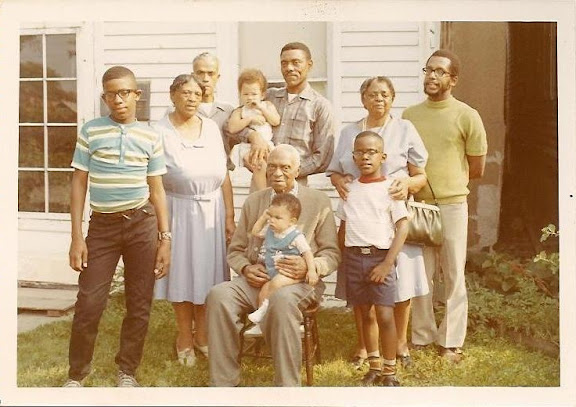
My great-great grandmother, “Grandma Duncan”, was a very fair-skinned Black woman. Her mother was a “Mulatto”—the daughter of the White slave master by his Black slave (hence my great grandma’s “good” hair). I never had a chance to know Grandma Duncan, as she died in 1946. However, I did know Grandpa Duncan’s second wife, “Miss” Colona. Colona Duncan was also a very fair-skinned Black woman. She died a year before Grandpa Duncan. I’m told Grandpa Duncan didn’t want to marry “no dark-skinned woman”. If you remember his picture (seated in the center), you know Grandpa Duncan was dark-skinned. What was his rejection of dark-skinned Black women, but a form of self-hatred? You must understand, however, that this is what societal racism does to a person’s self-image. It almost makes one want to weep for the damage that has been done to Black people in America.

By the way, my wife happens to be fair-skinned (and, yes, she has “good” hair, also).
I think Grandpa Duncan would have been pleased.

~~~~~~~~~~~~~~~~~~~~

I’ve been called a “Nigger”, in my hearing, five times in my life: once in 5th grade (by a “Navy brat”, a child whose parent was stationed at Great Lakes Naval Base; not a native North Chicagoan); once in 7th grade (by another “Navy brat”); at a summer music camp, when I was almost 14; by one of my (short-lived) college roommates, as he grabbed me by the collar and shoved me against the wall; and, when I taught in a middle school, by a student in a crowded cafeteria. With such a crowd, I couldn’t identify who said it, although I know it was directed at me since I was the only Black person in the entire school building (and the only Black adult that I ever saw in the entire school district!). My experiences have taught me that “Nigger” is the weapon-of-choice for weak, cowardly, White people. When they can’t think of anything legitimate or intelligent to say, they always reach back for that word.

~~~~~~~~~~~~~~~~~~~~

“Nigger” is used by Black people, too. My great grandparents used the word not infrequently, when referring to certain “choice” Black people. And, I’ll tell you right now, it was never meant as a compliment. However, my wife (who is a public high school teacher) informs me that some young Black people now throw around the word almost as a term of endearment, thereby encouraging a few White youngsters to use the word, also…and not just in reference to Black people! I can only shake my head in disbelief. It reminds me of that stupid question I’ve heard an occasional White person ask: “Why is it all right for Black people to say ‘Nigger’ and not White people?” I always feel like asking, “Why are you worried about it? Do you want to use the word? And why would you want to use it?”

~~~~~~~~~~~~~~~~~~~~

Don’t refer to sin as “black”. Sin is not black. The Bible says, “Though your sins are like scarlet…though they are red like crimson” (Isaiah 1:18). Sin is not black; sin is red.

~~~~~~~~~~~~~~~~~~~~

I don’t want any pictures of Jesus. I don’t even picture Jesus in my mind when I pray. Any picture that I, or anyone else, would come up with would be inaccurate, and unworthy of the Savior. One thing I do know: Jesus wasn’t blond-haired and blue-eyed! Most everything in our society says that White is better, prettier, more handsome, etc. The last thing Black people need is some picture telling them that even Jesus was a European!

~~~~~~~~~~~~~~~~~~~~

Two Scripture passages every Black child ought to know and memorize (and, of course, there are thousands more):

Psalm 139:14a—“I praise you, for I am fearfully and wonderfully made.” Because every Black child needs to know that they are a beautiful creation of God.

Romans 8:31b—“If God is for us, who can be against us?” Because every Black child needs to know that if they stay on God’s side, it won’t matter who hates you.

Tuesday, February 13, 2007

My experience in “cross-cultural missions” (Part 6)

When I started this series, I was talking about the fact that I’ve never felt the need to go on a short-term mission trip (Part 1). It’s not that I have anything against mission trips; I’ve just never felt the urge to go on one myself. As far as I’m concerned, I’m already doing cross-cultural missions. You see, a little over six years ago, my family and I began attending a predominantly White, non-denominational, evangelical church. Eventually, both my wife and I became members, and we and both our sons are actively involved in the life of the church. However, because there is a whole world of difference between predominantly White churches and the Black Church, serving in our church is very much akin to cross-cultural missions, with totally different ways of doing “church”: different style of worship, different styles of music, different way of administration, different style of pastoral leadership, different ways of doing ministry, different expectations…a different world! There’s even a different “language”. So, what I set out to do is describe my experience in “cross-cultural missions”.

However, over the course of this series (as in some of my face-to-face conversations), I’ve become a bit sidetracked by following an extensive “rabbit trail”. First, I tried to describe the reasons why my wife and I decided to leave the familiar surroundings of the Black Church (Part 2). Then, I attempted to explain why there exists a humanly insurmountable gulf between Blacks and Whites, which also accounts for the separation between Black and White Christians and their churches (Parts 3 and 4). I am under no illusions that this divide can be healed before Christ returns. As long as sin is in the world, there will be racial and ethnic divisions and hostilities. However, I believe this gulf can be bridged in Christ, and that Christians have an obligation to demonstrate before the world that the Spirit of Christ can do the impossible. Starting with my last installment in this topic, I’ve been trying to explain what, in my opinion, needs to happen for Black and White unity to occur. In Part 5, I contended that Christian Blacks must be willing to forgive Whites for sins of racism that have been committed against them, and then “let it go”. In my opinion, unless we Blacks draw upon the Spirit’s power to overcome past hurts, we will not see racial harmony in the Church.

Today, I’d like to suggest some part that Christian Whites can play in racial reconciliation within the Body of Christ. Then, in what I hope will be my final post under this title, I’ll try to briefly describe some of the positive ways my family and I have connected with and ministered to our church family (“cross-cultural missions”) with the hope that it can serve as an example of how people of all races and ethnicities can successfully work together within the Body of Christ.

Two posts ago, I wrote the following: “Christian Whites need to both acknowledge this country’s racist past and admit that racism is still a problem. It’s an insult to Black people to pretend it doesn’t matter. It does matter. Even if your ancestors came to this country after slavery was abolished and had nothing to do with slavery, you still enjoy—as a legacy of our country’s racist past—privileges that go along with being White.” I’d like to try to explain this statement, if I can, for I think it also is a crucial part of any significant progress toward racial reconciliation.

In a previous post, I made clear that the slavery of Black people in the United States ended only 142 years ago. There are those who would say that was a long time ago, so we should just forget about it and move on. But, in terms of human history, Black people were enslaved a relatively short time ago. It is, therefore, an insult to suggest that Black people should just forget about the past and move on, as if everything’s all right now. Black people, as a group, are still affected by slavery and slavery’s racist aftermath.

I don’t have the statistics in hand, but we’re all familiar with them: As a group, Blacks are among the poorest, the least education, and comprise the largest racial group in most of our country’s prisons. We have a higher than average unemployment rate, live in some of the poorest areas of our nation’s cities (areas with some of the highest rates of crime), and have the lowest life expectancy. Every ethnic group that has immigrated to this country, even if they came in at the bottom rung of society, within two or three generations has ascended into the mainstream. Black people were brought to the Americas beginning in the early 1600s. We came in at rock bottom—as slaves—and, somehow, a large percentage of us remain at or near the bottom today.

What’s wrong? I think what we see is the lingering effect of slavery. Think about it: No other people group in the United States was ever subjected to life-long slavery, followed by decades of segregationist laws, plus the daily, almost routine onslaught of racial indignities that the average Black person used to face (and still do, on occasion but, thankfully, to a far lesser degree than our forebears). That collective experience leaves its mark on the psyche of a people. My advice to my White brothers and sisters is, please, don’t trivialize the Black experience by suggesting that Blacks should just “get over it”. You don’t “get over” what Black people have been through. By the grace and help of God, many of us have risen above our backgrounds and the hardships experienced by former generations. More Blacks than ever are now part of the “Middle Class”. God has been good. But, to forget the past, to my mind, is to forget that my great-great-great grandparents were slaves, forget that they never learned to read, forget that their children and grandchildren picked cotton and “slopped” hogs down South, then came North to work in factories and scrub floors, or cook and clean for White people, so that generations yet to be born could have a better life.

I hope you can see, then, why some Blacks might find it a major “turn-off” (to say the least) to suggest, “Since slavery was so long ago, we should just forget about the past and move on.” It would be help lesson the divide between Whites and Blacks, if Whites and others would be willing to face squarely the fact that Black slavery, segregationist laws, racial discrimination, and countless other indignities, brutalities and atrocities happened to Black people, right here in the U.S. Black people need to know that you don’t devalue their suffering. It would also help lesson the racial divide between Whites and Blacks, it Whites and others would be willing to admit that the sins of America’s past still affect our country. The simple truth is, all sin carries its consequences. Black people need to know that you appreciate the complexity of the moral, social and economic problems that plague many Black communities, as well as understand that a past climate of racism not only hampered the Black community but also sometimes gave a boost to the White community. To borrow an oft-used phrase: Blacks and Whites in America haven’t played on an even playing field.

So, then, what does racial harmony look like in the church? I can’t speak for every church, but I know how things have been for me and my family these past six-plus years within our church.

(To be continued…)

Saturday, February 03, 2007

My experience in “cross-cultural missions”

One of the recent trends in evangelicalism is the short-term mission trip. Instead of giving decades of one’s life to ministry for the cause of Christ in some faraway country—as legendary missionaries of the past like William Carey, Hudson Taylor, David Livingstone or Amy Carmichael did—today’s would-be missionary can give a couple or so weeks of service sacrificing little, risking little, investing little.

Without getting into the pros and cons of short-term mission trips, I have to confess I’ve never had even the slightest urge to go on one (I know that will sound like near-heresy to some). I figure, why should I go to another country for missions work when I’m already doing “cross-cultural missions”. You see, for the past 6 years my family and I have been involved in a predominantly white, non-denominational, evangelical church.

I hope no one will find my association of the term “cross-cultural missions” with involvement in a predominantly white church offensive. I’m simply acknowledging a cultural and sociological reality: There is a vast world of difference between the white evangelical church and church in the Black community. In fact, the move to a predominantly white church has meant learning a whole new way of “doing church”.

I’ve always been in church. My great grandparents were faithful church attendees and brought me to church every Sunday from the time I was 2 months old. Not only was I in church every Sunday of my life (unless I was sick—a rare occurrence), but I’ve been active in the church since childhood, ever since my great-great aunt “made me” come and play the organ for the brand new A.M.E. Church she became a part of way back in 1972. I was 9 years old at the time. So, for over 34 years I’ve been involved “up-front” in the church. I was active in the church even before I knew the Lord (I’ve been a Christian for a little over 26 years)! However, all my church experience, until 1998, was within the “Black Church”—within a Black local church in the Black community, within an historically Black denomination.

When we left the A.M.E. Church in 1998, we immediately united with a Black evangelical church (a Black local church which was part of a majority-white evangelical denomination). There were some significant differences between this Black church in a white denomination and a Black church within a Black denomination (a subject worth a blog post of its own), but I was still dealing with Black folk.

But, when my wife and I made the decision to attend a white church, we made a decision which (probably more so for me than for my wife) was earth-shaking. I don’t think I’m being overly dramatic in speaking of our decision in those terms. Leaving behind the comfort and security of Black people on Sunday morning meant leaving behind everything we had known and become used to. It meant leaving behind familiar sights and sounds. It meant singing new music or singing familiar music (hymns) in new ways. It meant a different way of worshiping, a new way of praying in public, and listening to a different way of preaching. It even meant learning a new language: “evangelical-speak”.

So, whenever the subject of short-term mission trips comes up, I think to myself, “I don’t need to go on a mission trip to experience and minister to another culture; I’m doing that right now!”

(To be continued…)

Wednesday, January 31, 2007

Seeing through these Black eyes

February, as everyone in the U.S. should know, is African-American or Black History Month. Carter G. Woodson (1875-1950), who is known as the father of Black History, believed that in order to participate effectively in American society, Blacks needed to know about their history, a history that, tragically, had been erased, obscured and ignored as a result of the evil of slavery and the racial prejudice and discrimination against African people and their descendants which gave birth to slavery and continued in slavery’s aftermath. Woodson believed it was necessary for all Americans to know the important and significant contributions that Blacks have made to America. I agree with Woodson. The need still exists.

For those who would like to know more about Carter G. Woodson, I have links here, here and here.

In the interest of Black History month, I’d like to do something different. I’d like to spend the majority of February writing especially from my “Black self”. That is, I would like to expose my readers to some of my thoughts as a Black, Christian man in America. My wife and sons are already familiar with my views, so nothing I’ll write will be news to them. I’ve talked about these things many times at our dinner table, while riding in the car, relaxing in front of the television or doing yard work. Nothing I will write is “news” to those who know me best. But to others, especially those who are not Black, much of my “Black self” remains hidden. In my opinion, wearing this kind of racial “mask” is necessary to smoothly navigate life in America. It’s a survival technique (In that vein, I would recommend you read the classic and eye-opening 1952 novel, Invisible Man, by the late writer and novelist, Ralph Ellison). However, masks do not promote understanding. This is why, in the interest of racial understanding, I would like to remove the mask and let non-Blacks see America and the evangelical church through these Black eyes.

I don’t think my racial views are all that unique among Black people—not at all. In fact, I think my views are pretty much middle-of-the-road. On one extreme, I’ve known Blacks who definitely harbor hostility and racism against whites. On the other hand, I suspect I’ve met a few Blacks who seem to have forgotten that they are Black (and, I don’t mean that as a compliment, by the way). I’m thinking of Black people who act as if they wish they were white, who look down their noses at people of their own race. In contrast to these extremes, I do not hate anyone of another race, neither do I reject my own race and racial heritage. Now, there have been times, because of hurtful racial experiences, when I have struggled with hatred against whites, and there have been other times when I’ve felt like turning my back in disgust on Black folks. However, as far as I know my own heart, at this stage of life I do not hate or feel hostility against anyone, and I love and respect (and like!) people of various races and ethnicities. And, I mean specific people, not just a nameless, faceless, nondescript group of people. Anybody can love people “in general”. I must give all glory to God because, more than once, I’ve had to pray for genuine love for people (white and Black) who’ve hurt me, and God has answered that prayer.

Most of what I have to write will be about Blacks and whites. I don’t mean to ignore other races or ethnicities, but the fact is, being Black in America has always been mainly about trying to live, work and relate with whites. So, please don’t take offense if I’m not talking about you; there will be something here, I think, for all to learn. However, there’s a history between Blacks and whites in America that goes back a l-o-n-g way. It is out of my personal experience, within this continuing saga of Black-white relations, that I will be writing.

So, I pray that you will bear with me. I pray that you will read and listen to what I’m trying to say, especially if you’re not African-American. I’m not trying to bash anybody or any group, but I’m concerned that the Church in America still doesn’t “get it”, when it comes to race. In particular, I think conservative, evangelical, Christian whites need to know what it’s like to be Black. You need to understand that not every Bible-believing, evangelical-minded Christian sees the world as you do. I’m going to try to share my heart. I pray that God will, in some way, use what I write for good and for His glory.